Customers expect an answer now, on the channel they already use, at any hour. For most businesses that is hard to deliver. Support teams spend much of the day answering the same questions about order status, prices, opening hours and password resets, while urgent or complex requests wait in the same queue. Hiring more people helps for a while, but it does not fix nights, weekends or sudden spikes.
That is why AI customer service has moved from experiment to priority. Modern AI chatbots and AI agents can understand a question written in everyday language, answer it from your own policies and data, take simple actions such as checking an order, and pass the conversation to a person when it needs one. Done well, customers get faster answers and your team spends its time where people make the difference. Done badly, AI becomes a wall between customers and help, and it can create legal and reputational problems.
This guide explains what AI customer service is, why it matters in 2026, how it works, the use cases that pay off, the risks and rules to plan for, an 8-step implementation plan, what drives cost, and the KPIs to track. It is written for founders, operations leads and support managers, not just engineers.
AI Customer Service at a Glance
Quick answer: AI customer service uses conversational AI, such as chatbots, AI assistants and AI agents, to answer customer questions and complete routine tasks automatically across channels like your website, WhatsApp and email, while handing more complex or sensitive conversations to human agents with the full context.
- What it automates well: FAQs, order and booking status, simple account changes, lead qualification, appointment scheduling and after-hours replies.
- What it needs: an accurate knowledge base, connections to your systems (CRM, help desk, order database) and a clear human handoff.
- Where it fails: outdated knowledge, no way to reach a person, and AI allowed to promise things your policies do not support.
- How to start: pick the two or three most common request types, automate them on one channel, measure, then expand.
What Is AI Customer Service?
AI customer service is the use of artificial intelligence to handle parts of customer support that used to need a person. The older generation of support bots worked from fixed decision trees: press 1 for billing, choose from four buttons, type an exact keyword. They broke as soon as a customer phrased a question differently.
Today's tools are built on large language models (LLMs). They understand free-form questions, follow a conversation, and write natural replies. In practice, AI customer service usually combines three layers:
- AI chatbot or AI assistant: answers questions in conversation, using your knowledge base as its source of truth.
- AI agent: goes beyond answering. An AI customer service agent can take actions through your systems, such as looking up an order, rescheduling a booking or creating a ticket, within limits you set. This is often called agentic AI.
- AI help desk features for your team: suggested replies, conversation summaries, automatic tagging and routing, which make human agents faster rather than replacing them.
AI customer service is not a single product. It is a set of capabilities you add to the channels and tools you already have, which is why integration matters as much as the AI model itself.
Why AI Customer Service Matters in 2026
Three developments make 2026 a turning point for AI customer service.
The technology now handles real tasks
In March 2025, Gartner predicted that by 2029 agentic AI will autonomously resolve 80% of common customer service issues without human intervention, leading to a 30% reduction in operational costs. That is a forecast, not a result, but it shows where the industry is heading: from AI that suggests answers to AI that completes requests.
Early adopters have published their own results. In February 2024, Klarna reported that its AI assistant handled 2.3 million conversations in its first month, two-thirds of its customer service chats, doing work equivalent to 700 full-time agents, with issues resolved in under 2 minutes compared with 11 minutes before. Klarna also noted that customers could still choose to talk to a live agent. These are self-reported figures from a large company with a lot of data, so treat them as an example of what is possible, not a benchmark for every business.
Customers are cautious
Speed is not the whole story. A Gartner survey of 5,728 customers, published in July 2024, found that 64% would prefer companies did not use AI for customer service, and 53% would consider switching to a competitor if they found out a company was going to use it. The top concern was that AI would make it harder to reach a person. The lesson is clear: AI customer service has to make help easier to reach, not harder.
Replacing people entirely is not the plan that works
In June 2025, Gartner predicted that 50% of organisations that expected to significantly reduce their customer service workforce will abandon those plans by 2027. The winning model is hybrid: AI handles volume and routine work, people handle judgement, empathy and exceptions, and both share the same customer history.
How AI Customer Service Works
Behind a simple chat window, a well-built AI customer service system follows the same path for every message:
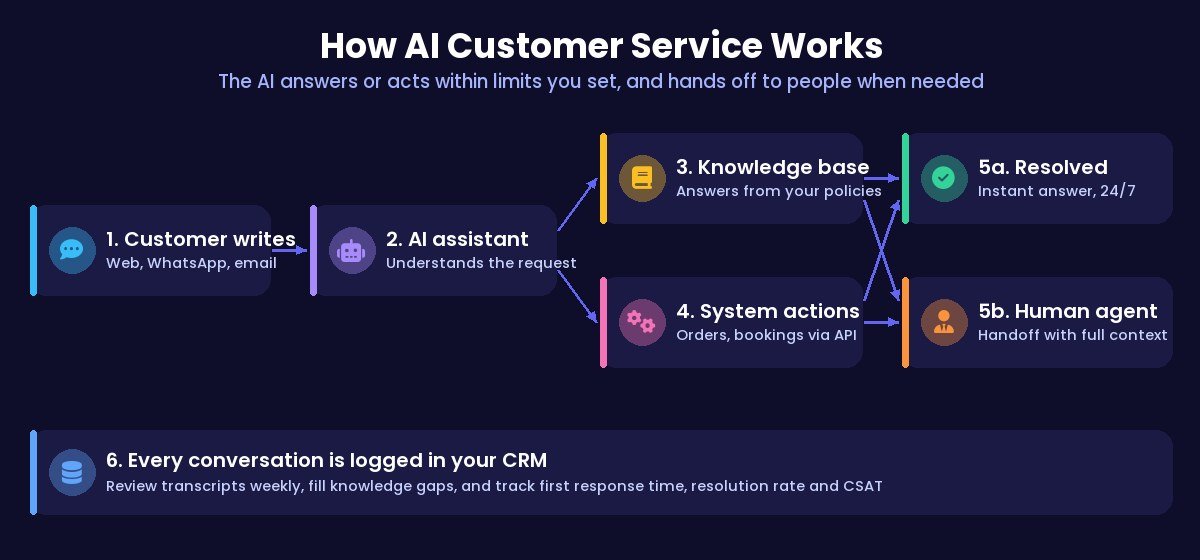
- The customer writes in on your website chat, WhatsApp, email or app.
- The AI understands the request, working out the intent (for example, "where is my order?") and any details such as an order number.
- It retrieves the right knowledge. Most business assistants use retrieval-augmented generation (RAG): the AI searches your knowledge base, such as policies, product information and FAQs, and answers from those documents rather than from general internet knowledge.
- It takes action if allowed. Through API integrations, an AI agent can check an order, update an address or book a slot. Each action should have clear permissions.
- It resolves or hands off. If the request is outside its scope, the customer is upset, or the customer asks for a person, the conversation moves to a human agent with a summary, so the customer does not have to repeat themselves.
- Everything is logged in your CRM or help desk, so you can review conversations, improve the knowledge base and measure results.
The AI model is only one part of this. The quality of your knowledge base, the integrations and the handoff design decide whether customers have a good experience.
7 AI Customer Service Use Cases That Pay Off
The best starting points are frequent, predictable and low-risk. These seven use cases work for most businesses.
1. Answering FAQs around the clock
Delivery times, return policies, pricing, opening hours and "how do I" questions make up a large share of support conversations. An AI chatbot for customer service can answer them instantly at any hour, using the same approved answers your team would give.
2. Order, booking and ticket status
"Where is my order?" is the classic example. Connected to your order system or courier tracking, an AI agent can give a real answer in seconds instead of a generic reply.
3. Appointment scheduling and reminders
Clinics, salons, service businesses and education providers can let customers book, reschedule or cancel in a conversation, and send automated reminders to reduce no-shows.
4. Lead qualification and routing
Not every incoming message is a support request. AI can ask a few qualifying questions, such as budget, location or product interest, then create a lead in your CRM and route it to the right salesperson. This is where customer service and sales meet.
5. Simple account changes
Updating an address, changing a plan or resending an invoice are routine tasks an AI agent can complete safely when the customer is verified and the action is within agreed limits.
6. Multilingual support
LLM-based assistants can reply in many languages, which helps businesses serving customers across regions. Check the quality for your key languages and keep a human review path for sensitive conversations.
7. Help for your human agents
AI does not have to face customers to add value. Suggested replies, automatic summaries, tagging and sentiment flags help your team handle more conversations with less effort, and they are a low-risk first step.
Chatbot vs AI Agent vs Human: Who Handles What
A clear division of work is the foundation of good AI customer service automation. Use this as a starting point and adjust it for your business.
| Request type | Best handled by | Why |
|---|---|---|
| FAQs, policies, product information | AI chatbot / assistant | High volume, answers come from your knowledge base |
| Order status, booking changes, invoices | AI agent with system access | Needs data and actions, but follows clear rules |
| Lead qualification | AI, then a salesperson | AI collects details fast; people close deals |
| Complaints and upset customers | Human agent (AI summarises) | Needs empathy and judgement |
| Refunds, exceptions, legal or medical topics | Human agent | Higher risk; decisions need accountability |
| Anything the customer asks a person for | Human agent | Respecting that request builds trust |
Risks, Rules and the Human Handoff
AI customer service creates new obligations. Plan for these from the start rather than after launch.
You are responsible for what your AI says
In Moffatt v. Air Canada (2024), a Canadian tribunal held the airline responsible after its website chatbot gave a customer wrong information about bereavement fares. The tribunal rejected the argument that the chatbot was responsible for its own words. For any business, the takeaway is simple: limit the AI to approved knowledge, tell it not to invent policies, and route anything involving money, refunds or legal commitments to a person.
Tell customers they are talking to AI
The EU AI Act's transparency rules apply from 2 August 2026. Under Article 50, AI systems that interact directly with people must be designed so that people know they are talking to an AI, unless that is obvious. If you serve customers in the EU, add a clear disclosure at the start of the conversation. It is good practice everywhere, and it supports trust.
Protect customer data
Support conversations contain personal data such as names, phone numbers, addresses and order history. Collect only what you need, control who can see it, and choose AI providers whose data terms you understand. Businesses serving Indian users should also plan for the Digital Personal Data Protection Act; our DPDP Act compliance checklist covers the basics.
Follow channel rules
On WhatsApp, the WhatsApp Business Messaging Policy requires customer opt-in before you message people, and Meta bills business messages: marketing templates are always charged, and from 1 October 2026 service replies are billed per message too. Design your AI customer service flows to answer well and close conversations efficiently. Our WhatsApp Business API guide explains the pricing model.
Design the handoff first
The single biggest fear customers have is not being able to reach a person. Make "talk to a human" always available, hand off automatically when the AI is unsure or the customer is frustrated, pass the full conversation and a summary to the agent, and set expectations for response times outside working hours.
How to Implement AI Customer Service in 8 Steps
- Audit your conversations. Export a few weeks of chats, emails and tickets. Group them by request type and count how often each appears. The top few types are your first automation candidates.
- Set goals and limits. Decide what success looks like, such as faster first responses or more requests resolved without a person, and what the AI must never do, such as approving refunds.
- Build the knowledge base. Write clear, current answers for your top request types, plus policies, product details and pricing rules. This is the most important step and usually the most underestimated.
- Choose your channels. Start where most customers already contact you, often the website chat or WhatsApp, and add others later.
- Connect your systems. Integrate the CRM, help desk, order database or booking system the AI needs. Use read-only access first, then add actions with permissions.
- Design the handoff and disclosure. Define when and how conversations move to people, who receives them, and how the AI introduces itself.
- Test with real questions. Run past conversations through the assistant, include tricky and adversarial ones, and have your support team review the answers before launch.
- Launch small, then improve weekly. Go live on one channel and a few use cases, review conversations every week, fix knowledge gaps and expand step by step.
For a broader view of automating business workflows, see our business process automation guide for SMEs, and if you are deciding between a ready-made tool and custom development, our build vs buy guide can help.
What Affects Cost and Timeline
There is no single price for AI customer service, because projects range from switching on a platform feature to building a custom AI agent connected to several systems. These factors drive cost the most:
- Platform or custom build: using a ready-made tool is faster and cheaper to start; a custom build gives more control over workflows, data and integrations.
- Number of channels: website chat alone is simpler than website, WhatsApp, email and app together.
- Integrations: each connected system (CRM, help desk, ERP, order or booking system) adds design and testing work.
- Actions vs answers: an assistant that only answers questions is simpler than an agent that changes orders or bookings.
- Knowledge preparation: clean, current documentation shortens the project; scattered or outdated content lengthens it.
- Usage costs: AI model usage and channel fees, such as WhatsApp message charges, grow with conversation volume.
- Languages and compliance: more languages and stricter data requirements mean more testing and controls.
As a rough guide to timelines, a focused FAQ assistant on one channel can often go live in a few weeks, while an AI agent integrated with several business systems typically takes a few months, including testing. Our AI chatbot development cost guide breaks the budget down in more detail.
AI Customer Service on WhatsApp With ConverseIQ
For many businesses, especially in India, the Middle East and other WhatsApp-first markets, customer service already happens on WhatsApp. That is why we built ConverseIQ, the AI-powered WhatsApp platform and CRM from CodeBase Coders. It brings the main building blocks of AI customer service on WhatsApp into one workspace:
- Shared WhatsApp inbox with quick replies and team access, so several people can handle conversations from one number.
- WhatsApp chatbot to answer common questions, collect details and route conversations.
- AI assistant with a knowledge base you control, plus AI settings to shape how it responds.
- Built-in CRM that keeps every contact's conversation history, with lead automation and advanced automation for follow-ups.
- Chat widget and QR codes to start WhatsApp conversations from your website, store or packaging.
- Consent tracking, analytics and reports to support opt-in rules and show how conversations perform.
- Developer access with an API so your website and other systems can send leads and data in.
Because the chatbot, AI assistant, inbox and CRM are one system, a human agent who takes over a conversation sees exactly what the customer asked and what the AI answered. That is the hybrid model that works. You can read more in our ConverseIQ launch article or explore ConverseIQ directly.
KPIs to Measure AI Customer Service
Track a small set of metrics from day one, and compare them with your figures before launch:
| KPI | What it tells you |
|---|---|
| First response time | How quickly customers get a first reply, on every channel and at every hour |
| Resolution rate without handoff | The share of conversations the AI fully resolves; check it alongside satisfaction, not alone |
| Handoff rate and reasons | Where the AI falls short and which knowledge or integrations to add next |
| Customer satisfaction (CSAT) | Whether automation is improving or hurting the experience |
| Repeat contacts | Whether issues are really solved or customers come back with the same problem |
| Agent time per conversation | Whether summaries and suggested replies are making your team faster |
| Leads and conversions from support chats | The revenue side of customer service, especially on WhatsApp |
Review a sample of real conversations every week. Numbers show trends; transcripts show why.
Conclusion
AI customer service is no longer about replacing a phone menu with a chatbot. In 2026, AI chatbots and AI agents can answer real questions from your own knowledge, take routine actions in your systems, and work around the clock across channels like your website and WhatsApp. The research points the same way: AI can take on much of the routine volume, but customers want to know a person is there when they need one, and businesses remain responsible for what their AI says.
The businesses that get the most from AI customer service start with their most common requests, invest in a clear knowledge base, connect the AI to the systems that hold the answers, design a fast human handoff, and improve every week. If you want help planning or building that, CodeBase Coders can take you from audit to launch, and if WhatsApp is your main channel, ConverseIQ gives you a ready platform to start with.
Frequently Asked Questions
What is AI customer service?
AI customer service uses conversational AI, such as chatbots, AI assistants and AI agents, to answer customer questions and complete routine tasks automatically, while handing complex or sensitive conversations to human agents. It works across channels including website chat, WhatsApp and email.
Will AI replace customer service agents?
For most businesses, no. AI handles repetitive, high-volume requests, while people handle complaints, exceptions and decisions that need judgement. Gartner predicts that half of the organisations that planned big cuts to their customer service workforce because of AI will abandon those plans by 2027, which supports a hybrid model.
What is the difference between an AI chatbot and an AI customer service agent?
An AI chatbot mainly answers questions in conversation. An AI customer service agent can also take actions through your systems, such as checking an order, rescheduling a booking or creating a ticket, within permissions you define.
Can I use AI customer service on WhatsApp?
Yes. Through the WhatsApp Business Platform, you can connect a chatbot or AI assistant to your WhatsApp number, as long as you follow WhatsApp's opt-in rules and account for Meta's message charges. ConverseIQ, from CodeBase Coders, combines a WhatsApp inbox, chatbot, AI assistant and CRM for this purpose.
How do I stop an AI assistant from giving wrong answers?
Limit it to an approved knowledge base, keep that knowledge current, tell it to hand off when it is unsure, route refunds and other commitments to people, test it with real past questions, and review transcripts regularly. No AI is perfect, so a quick path to a human is essential.
Do I have to tell customers they are talking to AI?
In the EU, yes: the AI Act's transparency rules, applying from 2 August 2026, require that people are informed when they interact with an AI system unless it is obvious. Elsewhere it is still good practice, because being open about using AI builds confidence with customers.
How can CodeBase Coders help us set up AI customer service?
CodeBase Coders starts with a short discovery of your support volume, channels and systems, then builds the pieces you need: an AI chatbot on your website or WhatsApp, an AI agent that can check orders or book appointments in your systems, AI integration with your CRM or help desk, and a human handoff that works. If WhatsApp is your main channel, we can set up ConverseIQ, our own WhatsApp inbox, AI assistant and CRM. Talk to us about your support workflow.
Sources
- Gartner (5 March 2025): Agentic AI will autonomously resolve 80% of common customer service issues by 2029
- Gartner (9 July 2024): 64% of customers would prefer that companies didn't use AI for customer service
- Gartner (10 June 2025): 50% of organisations will abandon plans to reduce their customer service workforce due to AI
- Klarna (27 February 2024): AI assistant handles two-thirds of customer service chats in its first month
- Moffatt v. Air Canada, 2024 BCCRT 149 (Civil Resolution Tribunal of British Columbia)
- Regulation (EU) 2024/1689 (EU AI Act), Article 50: transparency obligations
- WhatsApp Business Messaging Policy (opt-in)
- Meta for Developers: service message pricing, including the changes effective 1 October 2026
Work With CodeBase Coders
CodeBase Coders helps businesses turn ideas into scalable digital products and improve existing processes through software, automation, AI, integrations and modern web technologies. For AI customer service, we design the knowledge base, build the chatbot or AI agent, connect it to your CRM, help desk and business systems, and set up the human handoff, so automation helps customers instead of getting in their way.
- AI & WhatsApp Chatbot Development
- AI Agent Development
- AI Integration Services
- AI Consulting
- Custom CRM Development
- Software & API Integration
- ConverseIQ: our AI-powered WhatsApp inbox, chatbot and CRM
Ready to give customers faster answers without losing the human touch? Book a free consultation with CodeBase Coders and we will map out the AI customer service setup that fits your business. Explore everything we build at codebasecoders.com.
Rohan Verma
Founder, CodeBase CodersRohan Verma is the founder of CodeBase Coders. He helps startups, SMEs and enterprises turn ideas into scalable digital products and improve business processes through custom software, AI, automation, integrations and modern web technologies.